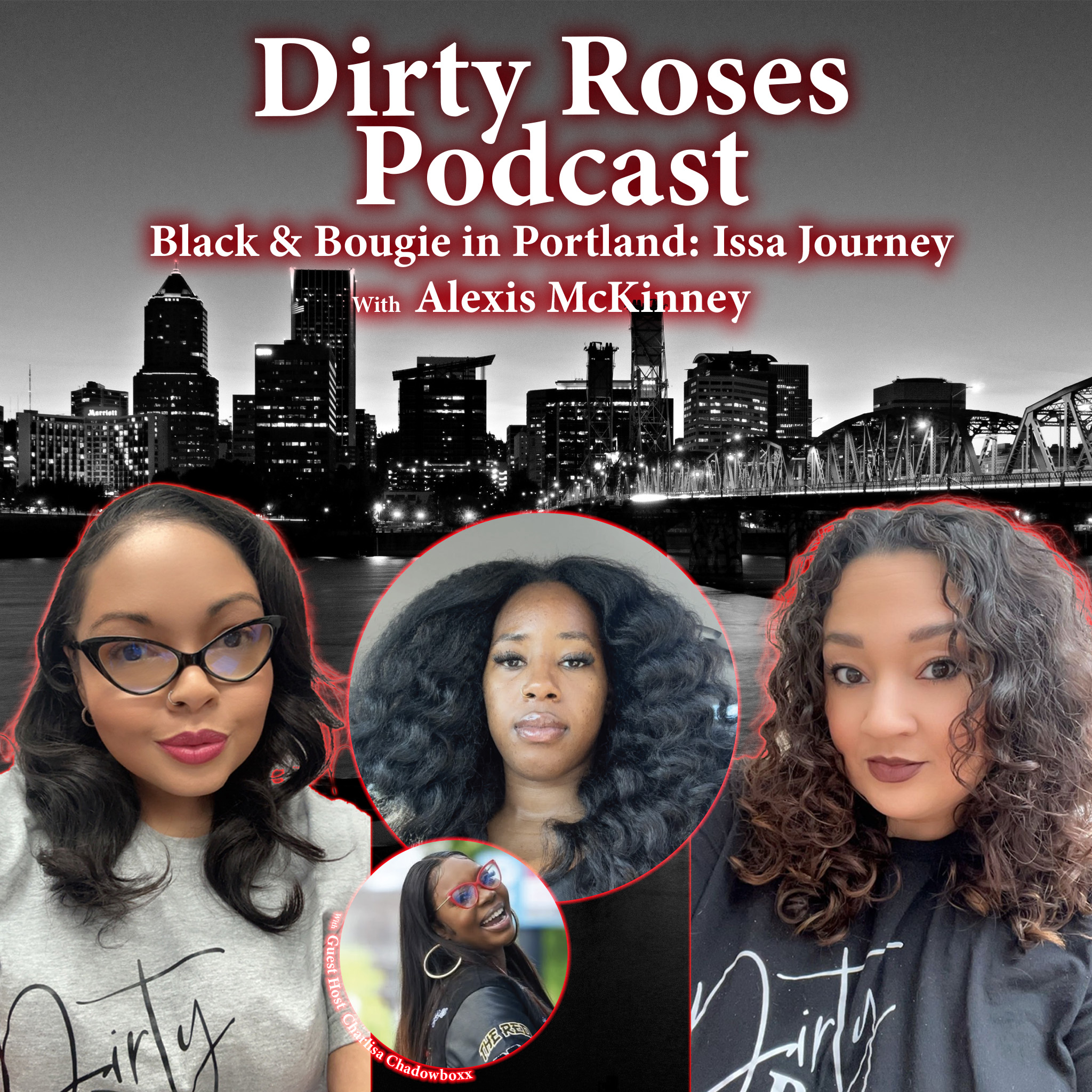
[00:00:00] Speaker A: I'm Lila Rie.
[00:00:01] Speaker B: And I'm Nick B.
[00:00:02] Speaker A: Listen, we're just two single girls from the city of roses discussing all things love, lust, and perception.
[00:00:08] Speaker B: And roses are a symbol of all things beautiful about love.
[00:00:11] Speaker A: But as you know, love can get a little dirty. So we're here to talk about it.
[00:00:15] Speaker B: Dirty Roses podcast starts now.
[00:00:18] Speaker A: Hey, I'm Lila Ree.
[00:00:20] Speaker C: And I'm Charlisa Shadowbox.
[00:00:21] Speaker A: And welcome to Dirty Roses Podcast.
Now, as you've seen pretty much every episode so far, we're missing a person, but that's why we got the guest host to come in and step in. Because, you know, we're doing the self care, we're doing our wellness, we're doing be a better version of ourselves than we were yesterday and every day prior to that. Absolutely. So Nick B. Is out for the season, but she is taking care of herself. She's documenting her journey. So make sure that you're following along because you get to see her every step of the way. And by the time that this show airs, she will be outside post surgery posting it.
[00:00:51] Speaker B: Listen.
[00:00:51] Speaker C: Yes, I can't wait to see.
[00:00:53] Speaker A: I'm trying to be in her presence because I know she gonna be acting a goddamn outside.
Yeah, she was outside this weekend, but she gonna be outside drinking protein drinks at the bar.
You, Nick.
[00:01:04] Speaker C: I love you, girl.
[00:01:05] Speaker A: We miss you.
But we are so excited today because we have had lots of conversations around this. And if you're not from Portland, you don't really understand the.
The seriousness of how a lot of this conversation has gotten started. But Portland, and black Portland particular, is a very small community. Now, granted, I ain't got no problem finding black folks. And, you know, the people that I hang around with ain't got a problem finding black folks, but it is a constant conversation, especially if you are from areas that have big populations. Now, we're only like 6% of the population of the entire state of Oregon, and pretty much all of us live in Portland or in the surrounding areas.
So that's not a lot of people. We get it. So when you move here, you know, you bring a vibe, you bring an energy, and sometimes it's not always well received. And our guest today recently just kind of had a viral moment that sparked a lot of conversations, triggered a lot of nerves, had lots of agreeing, you know, folks. And I'm a Portland native, but I totally agree with a lot of stuff that she said. And so I'm excited because not only have I got to see this girl in action when she be outside and Kicking it and doing her influencer content creator outside finding good things to do, Black girl magic stuff.
She, you know, is a professional in the sports world. She is a professional. Just, like, she loves food. She loves black people. She loves.
[00:02:32] Speaker C: She just makes everything look fun.
[00:02:34] Speaker B: Anything she does, just.
[00:02:35] Speaker C: I'm like, I want to do that.
[00:02:37] Speaker A: For some reason, as a person who, like, sees her, I'd be like, I want to be her friend. I know, because I would like some of the things she does.
[00:02:44] Speaker B: Yeah.
[00:02:45] Speaker A: For real.
[00:02:45] Speaker C: We hang out.
[00:02:46] Speaker B: For real.
[00:02:46] Speaker C: That was, like, when we first saw each other in person, it was crazy because I'm like, I already know you.
[00:02:51] Speaker A: Right, Right.
But such an authentic, genuine, beautiful soul. I'm so excited that we are being joined today by Ms. Alexis McKinney, aka Lex in the City.
[00:03:04] Speaker B: Yes.
[00:03:05] Speaker A: Yes.
[00:03:06] Speaker B: I love it.
[00:03:06] Speaker A: Thank you so much for joining us. Thank you.
Now we can kind of jump right into it. Where are you from?
[00:03:12] Speaker B: I'm from Milwaukee, Wisconsin. Born and raised.
[00:03:15] Speaker A: Yes. And how did you end up in Portland?
[00:03:17] Speaker B: I moved here for work, like many transplants tend to do.
[00:03:21] Speaker A: Got you. Because they don't come here by choice.
[00:03:23] Speaker C: Right.
[00:03:25] Speaker B: I never thought I would see myself in Portland. I do have family in Seattle, and in my mind, I was like, oh, Portland's not far from Seattle. It will be the same.
[00:03:33] Speaker A: Right.
[00:03:33] Speaker B: Was I surprised?
Okay.
[00:03:36] Speaker C: I thought you would tell me. It is different, right?
[00:03:38] Speaker B: It's very different.
And I have, you know, family.
I've always had black family around me, even though my dad did marry a white woman, which is also controversial.
I feel like I was surrounded by black people, so I was like, oh, it shouldn't be that different. And then I was like, okay, it's different. It's different.
[00:03:57] Speaker A: And it's funny because you hear a lot of Portland people talk about other states, like Milwaukee or, like, those areas, and you'd be like, there's black people there.
And it's weird because you hear those places, you think, you know, predominantly white. You know, think all those things.
[00:04:12] Speaker C: Yeah.
[00:04:12] Speaker A: Still not as wide as Portland, and it's crazy. So how do you. How do you, like, kind of navigate those mis. Misconceptions about your hometown?
[00:04:21] Speaker B: Yeah, I usually leave with, I'm from Wisconsin just to shake stuff up. You know what I mean? I'm like, y' all from Wisconsin? It's like, black girl from Wisconsin. Then I'm like, oh, I'll get specific and say Milwaukee. Either you heard of it or you haven't. But, yeah, my city's black. Like, it's 40%. Like, my principals were black. My teachers were black. Like, I didn't realize that that representation wasn't the common experience until I went to college, actually. People were like, I've never had a black teacher. And I was like, my social study teacher was black. My math teacher, econ, geography, like, the most random subjects.
[00:04:53] Speaker A: And did you go to an hbcu?
[00:04:55] Speaker B: I did not. I went to pwi.
[00:04:56] Speaker A: Oh, wow.
[00:04:57] Speaker B: My mom actually insisted.
[00:04:59] Speaker A: Really?
[00:04:59] Speaker B: Yeah. Because she was like, yeah. And first she chooses my school because I got a free scholarship, so.
[00:05:04] Speaker A: Oh, there's that. Yeah.
[00:05:05] Speaker B: But she was like, girl, you just got to get in. I work here. But she was like, I think you need to see what the real world is like. Living in Milwaukee is very segregated. It's actually one of the most segregated cities in America.
[00:05:18] Speaker C: It's crazy. A lot of people don't realize.
[00:05:20] Speaker B: Yeah, it's actually one of the most segregated cities in America, so. So she was like, you really are, like, around black people, and I want you to experience what it's like to be the only. I was like, okay, I'm not ready.
But honestly, without me going to my college, I'm not making it in Portland, right? Yeah. Like, my college experiences prepared me to deal with the whiteness of Portland. Like, very, like. Cause it was a Catholic Jesuit school, so it's kind of, like, liberally. Yeah. But that was the first time I had a white person ignore me. I was like, oh, we just talked in class. Like what? Like, I just. I just experienced so many microaggressions. And I had never experienced, like. I experienced, like, blatant racism, but never microaggressive racism. Like, that was new to me.
[00:06:06] Speaker C: That is so confusing, because this is the land of passive aggression.
[00:06:09] Speaker B: And it is so. So.
So without that college experience, I really wouldn't make it here.
[00:06:14] Speaker A: That's so funny. And I tell people I, like, I prefer the south when it comes to racism, because it's in your face. You know what to expect, you know who to steer clear from, you know where to go, where not to go. And it's no issue in Portland or in Oregon in general. It's just like, they claim to be, you know, liberal. They claim to be accepting. They claim to love diversity. But the minute you might step on their toes, it's a backstab. And they're going to smile at you while they're doing it. And you don't even know. You don't trust yourself to believe what's happening.
And that part is so different than being somewhere where it's Like a majority black.
[00:06:48] Speaker B: It is, it is, it is.
[00:06:50] Speaker C: And it's a jarring experience, too. Cause I always tell people I'm like, I didn't pay attention to being black until I moved here.
It wasn't like, at the forefront of everything. Now it's that same thing. Like, oh, wow, you're discriminating against me. Like, you know, it's because I'm black. Wow.
[00:07:05] Speaker A: I didn't.
[00:07:06] Speaker C: Hold up a minute.
[00:07:07] Speaker B: Can you experience so many different types of blackness? You know what I mean? You understand that black people aren't a monolith because you have experience. And I went to a black performing arts high school. So, like, I had all different types of black people. Nerdy black people, creative black people, super talented musicians. Like, it was very different to see that many different types of black people. So I didn't even have an idea of what blackness was.
[00:07:29] Speaker A: Got you in a stereotypical way.
[00:07:31] Speaker B: It was just like, oh, well, that's just the weird anime black kid over there. Right, right, right.
[00:07:37] Speaker A: It's like, for you. So that's just the weird anime kid. Like.
[00:07:42] Speaker B: We only felt our blackness if we were somewhere again, because it's a little racist. Like, they started creating those, like, policies where it's like, oh, you got to be a certain age and you start feeling it. And like, all the te. Like, third spaces started becoming more rule driven. And you're like, okay, this feels targeted.
[00:07:58] Speaker C: Like, I got you.
[00:07:59] Speaker A: Yeah.
[00:08:00] Speaker B: Okay. So you're like, oh, like, you. You're aware of it, but yeah. You're not thinking about how you're black every day.
[00:08:06] Speaker C: Yeah. Like, I really found you still navigate.
[00:08:08] Speaker B: Yeah.
[00:08:09] Speaker C: Outside of that. So there was still space for you.
[00:08:11] Speaker B: Yeah.
[00:08:11] Speaker C: If you weren't necessarily accepted over here.
[00:08:13] Speaker B: Yeah. And yeah, yeah. Like, you get. Everybody get bullied, but, like, you got bullied and you find the, the. You just find the kids that aligned with you.
[00:08:20] Speaker A: Right.
[00:08:20] Speaker B: And then. Right. I feel like I had my awakening in college. I was like, oh, I'm black.
[00:08:24] Speaker C: Like, wait a minute.
[00:08:25] Speaker B: Like, I'm a black woman. Like, and so I, like, did deep dives of, like, history and took so many classes and just learned so much of, like, let me be proud of this history. And I had history classes and I was aware, but I wasn't aware. Like, I had like, that. You know, everybody has a, like, self awareness of, like, oh, wait a minute.
Yeah.
[00:08:45] Speaker A: And see, I was fighting for that all through high school, but it wasn't like. It's weird because, like, you know, being biracial in Portland, go figure.
[00:08:50] Speaker C: I Tell Lee all the time. She's like the blackest.
The next person I've ever met in my life.
[00:08:57] Speaker A: Thank you. I appreciate you.
[00:08:59] Speaker B: No problem.
[00:09:00] Speaker A: But no, like, it's funny because growing up, I never, like, it was never that, like, people, like biracial people, like, had that identity crisis, and I've never had that. I was always black. It was whatever. And when I got to high school, it was always like, let me find my. I got African American studies, even though it was a white teacher teaching it, but he was really cool.
[00:09:17] Speaker B: It's always a white teacher, isn't it?
[00:09:18] Speaker C: It's always a white teacher.
[00:09:19] Speaker A: Some Dangerous Minds type shit.
[00:09:21] Speaker B: Always a white teacher.
[00:09:22] Speaker C: But they be so aware.
[00:09:23] Speaker B: But he was hella cool, though.
[00:09:25] Speaker A: He taught his whole section on Spike Lee cinematography. Oh, my God, I loved it. It was dope. It was so dope.
But then I always signed up for, like, the workshops and activities and camps for the at risk youth. Now, we talked about this earlier in our previous episode. I grew up in the Alameda district, which is like a nice area.
[00:09:43] Speaker C: Very not at risk.
[00:09:44] Speaker B: Whatever.
[00:09:45] Speaker A: I chose to be on the other side of the streets where I shouldn't have been, but.
But I was considered at risk youth. And I was like, I'm gonna take advantage of it. It's cool. It's whatever.
[00:09:55] Speaker B: Yeah.
[00:09:55] Speaker A: But when I got to college, I went to hbcu.
I was like, yeah, I can breathe. I felt so comfortable. And everybody talks about like the. The.
Like the. What's the word? When you. The. The wake up call or the.
[00:10:09] Speaker C: Oh, kind of like awakening.
[00:10:11] Speaker A: No, no. Like when you go somewhere and it's different.
Why can I think.
Shock, Culture shock.
It was like everybody's like, oh, I went to HBC when it was a culture shock from coming from Portland. And for me, because I always navigated with black people, it just felt like I felt more at home. I was like, cool, this is great. Then I came home and I was like, oh, right.
[00:10:33] Speaker C: Then you realize that. Yeah.
[00:10:35] Speaker A: And we talked about that, like. So folks that haven't left Portland or haven't left their area, even if it's not Portland. Any city. In any city.
[00:10:41] Speaker B: Yeah.
[00:10:42] Speaker A: Like, if you haven't left your hometown, you have a very closed mind of what things look like and how people should navigate. So how has that been for you, navigating Portland as a transplant? Navigating spaces where there's lots of people who moved here for jobs, but also finding community with people who are locals or natives from this area?
[00:11:02] Speaker B: Yeah, I feel like I have found A good balance of it, I would say pre pandemic, I was in the transplant bubble, which is very easy to get into, especially when you move for a job. And everybody's like, ooh, black professionals. Young black professionals. We hear. And so, yeah, it was. It was interesting. I moved here in 2017, and I feel like there was. I don't know if there was initiatives going on or what, but, like, 2017, 2018, 2019. We, like, joke that it's like, classes of black people that moved here. Like, the class 2017 is me.
Class 2018 is my friend last class 2019. Like, we all, like. We all, like, locked in.
[00:11:40] Speaker A: Do you have any yearbook?
[00:11:41] Speaker B: Yeah, literally, if we could do a yearbook, that'd be a thing. And all I remember is I went to, like, a day party. I, like, found friends on apps. I know that it's like. But I found.
[00:11:51] Speaker C: But that was the swipe that people were doing.
[00:11:53] Speaker A: Are you doing dating apps for friends?
[00:11:55] Speaker C: Yeah.
[00:11:56] Speaker A: Okay. I've got a lot of those.
[00:11:57] Speaker B: And I'd be like, I think people are weird now. This is weird. Okay, Yeah, I can leave it.
[00:12:02] Speaker C: There was a time when that was.
[00:12:03] Speaker A: Safe to do that.
[00:12:04] Speaker B: So this is pre pandemic, so keep in mind the time. And I was swiping. I like, Black Girl, Black girl. I wasn't even reading Black Girl, Black Girl. And one black girl, she was from Chicago, and I was like, oh, my Midwest sister, let me finna be locked in. She's like, when you move here? I said, actually, I haven't moved yet. Oh, wow. I thought, girl, I'm gonna be there next week. But I had moved here from la and in la, people were so nice to me, and we had a good community. And I was in Long beach, and, like, we had, like, a black. Long. Black and Long beach group, and we did everything together. And it was people from. People from Long beach, people from, like, transplants. So I was like, I need that when I get to Portland. So I'm like, let me just swipe. And so we went to a day party, and everybody. I don't know if a bunch of us just moved in, and we were like. You could tell, like, people looking at.
[00:12:44] Speaker A: You, and you're like, right, she ain't from here. Yeah.
[00:12:46] Speaker B: Everybody's like, okay. So, like, we walking up to people. I'm like, I'm not from here. I need friends. And people were just so nice back then. And I think the pandemic has made us a little bit more socially awkward. But back in that time, it was like, oh, you're not from here. And so it just was easy for me to be friends. Like, it wasn't hard at all.
Yeah, people were just nice, and then there was a group chat, and then that died. But. But, you know, scandals be happening.
[00:13:12] Speaker C: People be messing somebody.
[00:13:13] Speaker B: Yeah.
[00:13:13] Speaker C: That just messes stuff up for everything. Messing the whole rotation.
[00:13:16] Speaker B: Exactly. But at that time, it was so many of us that had moved that we were just doing, like, Cinco de Mayo stuff and, like, oh, what y' all doing this weekend? Even if it was a few of us. So I did not struggle that. But when the pandemic lit, I'm gonna tell y', all, like, 90% of the people moved. Really?
Yeah.
[00:13:33] Speaker C: So they were people who were like, we're out of here.
[00:13:35] Speaker B: Yeah. Like, either they just got laid off or just, like, sur. Circumstances just happened. And so I had to find. I was, like, cycling through friends during the pandemic because I was like, dang. Like, my friends left. Like, what am I supposed to do?
So that just kept having to make friends, and I felt like I was just kind of. I was doing what I was doing pre pandemic, which is being friends with. Everybody was black. In the pandemic, I learned I couldn't do that. I was like, oh, we don't have things in common. Yeah. I was like, oh, it's different. I can't. Like, it's not a safe space. So then I got more intentional.
Then I started throwing events, and then I started meeting people that way.
[00:14:08] Speaker A: Right.
[00:14:08] Speaker C: But what made you feel like it was.
Or, like, why did you venture into, like, starting to throw your own events? Like, did you.
You know, like, did you. What challenges did you face with putting on these events?
[00:14:21] Speaker B: Yeah.
[00:14:22] Speaker C: So.
[00:14:22] Speaker B: So I guess pre pandemic, I would throw, like, smaller, like, black woman things. I love throwing stuff for black women, so I love this. I love it. But I was doing, like, smaller events, and then, I don't know, it just kind of.
There was a lot of people, I guess it had a second wave, I guess. Class of 2022 came in.
Class of 2022 came in, and I was like, y'? All. Yeah. They was like, where the black people at? And I was like, oh, there used to be events. There used to be this, this and this. And everybody's like, we should do that. So then it just started, like, doing. That's just literally how it started. And then.
[00:14:49] Speaker C: Nice.
[00:14:50] Speaker B: Yeah. So then I started doing my own stuff, too, and it was doing stuff for black women in Washington County. Just doing stuff. And, you know, people get burnt out. Because building community for yourself or for other people, you realize you're not building it for yourself because you can.
[00:15:04] Speaker C: It's hard to do both.
[00:15:05] Speaker B: It's really hard. I was like, I have so many superficial. Like, I don't really know y'. All. I just gotcha. I need to have more depth. And so I started being more forthcoming with the things that I was into and just really talking to people and finding compatibility. Okay. Which was key because I was like, oh, we're not.
[00:15:21] Speaker C: The guiding thing wasn't just because you're black.
[00:15:23] Speaker B: No. It was like, let me get to know you. Like, it's okay to have some friend dates and then be like, okay, well, we just gonna be associ. And that's fine. Or maybe we can do more things and it can turn into more. And so I did that for, like, three years, and now I feel like I found community. And it's. I would say I have a good mix of people that are, like, from here and not from here. Like, some of my closest friends, like, I, like, are from here. Like, I know their parents, and, like, their parents are so nice. And one of my homegirls and her, like, and her fiance, like, their family is, like, so welcoming. And, like, I love his mom. I'm like, oh, my God, I love his mom. Like.
[00:15:58] Speaker C: Cause black folks will adopt some families.
[00:16:00] Speaker B: And they adopt me.
[00:16:03] Speaker A: And they're just.
[00:16:04] Speaker B: So nice, and they know I'm not. And I think a lot of people from here that I do know that I encounter do like me because I am really nice to people from here.
I keep it cute because I understand that when somebody moves to your city and complains a lot, it kind of hurts.
[00:16:20] Speaker A: Right?
[00:16:20] Speaker B: And I don't think we talk about that a lot enough.
And I experienced it when I was in college and all the Chicago kids moved to Milwaukee, and it was like, why y' all not open at 4am I was like, friend, people are alcoholics here. Like, I don't know what y'. All. Like, things.
[00:16:33] Speaker A: Like, that's a real thing.
[00:16:34] Speaker B: Yeah, like, things close. That too. And, like, I remember, like, I didn't like the Chicago kids at first. I remember thinking, like, damn, y' all moved here and all y' all do is complain. Like, playing. That's her. This is my hometown. I know it's not perfect.
[00:16:46] Speaker C: You start feeling protective over it. Yeah. You feel like you need to defend it to a certain degree.
[00:16:50] Speaker B: And I'm like, I know it's not perfect, but, like, you can go back to Chicago and So I understood that from my hometown perspective. So when I moved here, I was very old, open about Portland, because I was like, damn. I remember how it felt to have people be like, it's not like my city. It's not like my city. It does hurt. And I just think people don't really think that. Right. So. Because I approach that away. People that are from here are actually really nice to me because they know that.
[00:17:15] Speaker A: Right, right, right.
[00:17:16] Speaker B: And they know me from, you know, events, and they know me from things. And so people have always been nicer to me because they'll break. They might not know me, but, like, when they figure out who they're not. Okay. Like, you cool, right? Right.
[00:17:27] Speaker C: Yeah.
[00:17:28] Speaker A: Okay. What has been, like, one of the biggest complaints that you've noticed about Portland from folks that aren't from here, but also from people that are from here?
[00:17:37] Speaker B: I think not from here. It's just, like, where the black people at? I think I get that's like.
[00:17:41] Speaker C: I feel like that's so.
[00:17:43] Speaker B: Which is so lazy to me. Like, you lazy?
[00:17:45] Speaker C: It's where it is.
[00:17:46] Speaker B: It's lazy. Cause I see all the time.
[00:17:48] Speaker C: I'm like, I never have a problem leaving my house and seeing black people. That's the crazy thing about it. Like, even when you're like, I mean, my salon's in Troutdale.
[00:17:55] Speaker B: Yeah.
[00:17:56] Speaker C: I literally can still see black people that are out there. You know what I mean? So I just feel like when they say that. And I've had people say that, too, and then I'm like, well, where are you at? They're like, in Newport. I'm like, what you doing out there?
[00:18:09] Speaker B: What you doing out there?
[00:18:11] Speaker C: We ain't out there.
[00:18:12] Speaker B: Yeah, I think it's.
I think.
I think it comes back to being in cities of convenience where it's like, oh, I can see tons. Like, yeah. When I went home, I took my boyfriend home. He was like, I ain't seen nobody non black in days. I was like, yeah, you only seen black people because, again, it's segregated. So, like, once you understand, like, we gotta understand the history and the history of the places that we're at. Because, yeah, you go home to Milwaukee, you only gonna see black people. Cause my mama live on the north side. That's where the black people at.
You have, like, clearly defined black communities, and you just don't have that here through a lot of historical reasons. And I think it's important that people learn that.
[00:18:47] Speaker A: Yeah.
[00:18:48] Speaker B: But I think that's the biggest one that I hear from people. Like, it's not from here. And then you get into the food conversation, which y' all know.
Y' all know. That said people like, they be like, oh, my go. Also, hear me out.
This is my unpopular opinion. Hear me out. I don't think soul food is good in restaurants because we all have our individualized recipes and it's very hard to please everybody. And so I be like, give these people grace if they food sweet. That's just me. That's what they lineage did. I don't know what to tell y'. All.
[00:19:18] Speaker C: Like, exactly. So soul food is a cultural thing. And so expecting to go somewhere where it's mass produced is crazy. And that's why I always will say, like, where they, like, where's the soul food? In my opinion, soul food is supposed to come from your kitchen on Sunday.
[00:19:33] Speaker A: That part. You know what I'm saying?
[00:19:34] Speaker B: And I have some good soul food places here, but it's all up to your own taste palette. And it's just so. And everybody's like, you can say that about everybody. I'm like, yeah, but like Thai fried rice. Is this Thai fried rice? Like, it's not like, you know what I'm saying? That's not true.
[00:19:49] Speaker C: It's not the same.
[00:19:49] Speaker B: It's not the same to me.
[00:19:50] Speaker A: Cause there's not an argument about whether or not you put sugar in it.
[00:19:53] Speaker B: Or, you know, vinegar.
[00:19:54] Speaker C: Or vinegar.
[00:19:56] Speaker B: Using ham hocks, using turkey legs, turkey necks. Like, it's me.
[00:20:00] Speaker C: Yeah, yeah, exactly.
[00:20:01] Speaker B: It'd be too much. So that's why I. Popular variables.
[00:20:03] Speaker C: Yeah. Or the people with dressing. Oh, if you use jiffy, I don't want no part. Like, it is really a matter of a person's preference.
[00:20:10] Speaker B: And it's regional. Like, it's where your family from. Like, it's so much. So I'll be like, not too much.
[00:20:16] Speaker C: Not too much.
[00:20:19] Speaker B: Even black owned restaurants here that aren't even doing soul food. So I'd be like, not too much. Like, go get you some Amalfi's and get you some Italian. I don't know tell you, but there's so many too.
[00:20:29] Speaker C: There are so many different cuisines to have other than soul food. Like, how many. How many pieces of fried chicken can you.
[00:20:35] Speaker B: Because y' all be like, I don't.
[00:20:37] Speaker C: Even eat fried chicken. That's why she's laughing. Because I don't eat fried chicken.
[00:20:41] Speaker B: No. That's so funny.
[00:20:42] Speaker C: But it's true.
[00:20:42] Speaker B: But it's just like, okay, y' all ask for the food places, and y' all only talking about. And I'm like, I don't know.
[00:20:47] Speaker C: I.
[00:20:47] Speaker B: It, you know, I feel like food is touchy.
[00:20:50] Speaker A: There's also an air of mediocrity here in food.
Oh, my God, you folks will hype up certain people, certain place, because you.
[00:20:57] Speaker C: Like the people, but they feel, oh.
[00:20:59] Speaker B: Yeah, there's no room for feedback. And I will not be speaking on it, but there's no room for feedback anywhere.
[00:21:04] Speaker C: Y' all know, don't you be talking about my place. Like, these people get so in, they.
[00:21:07] Speaker B: Feel there's no room for feedback. And that's all that is. There's no room for feedback. There's no room for.
Oh, y' all not open. When y' all say, like, baby, there's no room for me.
[00:21:17] Speaker C: How dare you expect me to be here at 9 o'. Clock. What you talking about?
[00:21:20] Speaker B: I just never understood that. I'm treating you as a business first. So, like, I'm business oriented, so you do need to update that stuff. But I understand small businesses struggle. So I be, you know, I'm teary.
[00:21:32] Speaker C: They be the struggle.
[00:21:33] Speaker A: First thing, we give grace. And then, and this is as a culture in general, we give grace, but then that grace gets. Becomes an expectation or an entitlement. And then it's like, you know, now.
[00:21:43] Speaker C: You'Re like, you're just operating just very. Just mediocre because you feel like I can. Because you're supposed to give me a pass. Cause I. I mean, come on, man.
[00:21:51] Speaker A: We said professionalism is a white or black thing, right? You said you're gonna be open at a certain time. You're gonna be open at a certain time.
[00:21:57] Speaker C: Exactly.
[00:21:58] Speaker B: But, you know, it's okay. Like, I just. For me, I just simply won't go there. I really be. As a content creator, I get nervous about that type of stuff. Cause I'm like, I know that the culture is there. I've been researching for a while. I'm like, always in black Portland, just looking at the comments. I rapper and just kind of gauge because I'm like, I'm trying to read what I can and can't. What's the A theme? But, yeah, I don't know what people from here complain about. I haven't really heard people complain. I mean, they just. It's boring. I've heard it's boring. I've heard a lot of it's boring.
There's nothing to do.
Y' all don't be bored here. I'm like, well, you ain't left. So, yeah, if I lived in Milwaukee, I'd be Bored out my mind. Everybody.
[00:22:39] Speaker A: But every town is like that.
[00:22:40] Speaker B: Every town has the spots that everybody goes to. You kind of get bored of it. That's just a town, period. Especially, like a medium. Like a. A big, medium city. Like, that's normal to me. Yeah.
[00:22:51] Speaker A: Yeah.
[00:22:52] Speaker C: And then not only that, too, because people make it seem like we're all supposed to be interested in the same thing. So what happens is a lot of places will get kind of burnt out because everybody's flocking there.
[00:23:03] Speaker A: You know what I mean? Going to the different places.
[00:23:05] Speaker C: Yeah, yeah, yeah.
[00:23:07] Speaker A: That's why I said I got to be with the transplants, be at.
[00:23:09] Speaker C: Because, yes.
[00:23:12] Speaker B: I feel like I tell people, like, I follow DJs more than I follow venues in Light inside of, like, maybe like, an Alberta street pub and some of more, like, places that I'm like, okay, well, I know if I go here on a Sunday, outside of that, I usually follow the DJs. I have my DJs that I like. I have a DJs. And I'm like, all right.
And, you know, we. Yeah, we just don't go to those people. And I. I support everybody publicly, but I personally, I'm like, all right, I'm not going there. But, hey, that might be your crowd, and that's okay.
I'm not going to the 20something. I could tell when a venue is 20something. I'm like, ooh, you talking about. I'm not. You're not. I remember I went. I feel like. I think I went to Jackie's. I don't love people at Jackie's, but I went to Jackie's, and this boy was like, you not too old for me. I said, oh, how old are you?
[00:24:03] Speaker A: Listen, that is how I met the little young boy who took out a date.
[00:24:06] Speaker B: I said, not the Y. N's coming from my age.
He was like, 22. I said, I don't belong here.
[00:24:11] Speaker A: Listen, I knew I messed up once.
[00:24:13] Speaker B: I started getting born in 2000. Please get me up out of there.
[00:24:16] Speaker A: I knew I messed up.
[00:24:18] Speaker C: Yeah. No, get me out of here.
My big auntie and I do not.
[00:24:21] Speaker A: Want to be in the.
[00:24:22] Speaker B: Very much in the club.
[00:24:23] Speaker C: I don't.
[00:24:24] Speaker A: I knew I messed up when we exchanged numbers and he told me to put an emoji by my name.
[00:24:27] Speaker B: And I was like, we need to bring back generational spaces. That's my opinion. I need a.
When I was younger, I remember there was like, a 33 and up club. And I was like, what be going on over there? And I said, I know Why y' all did that? Because y' all knew.
[00:24:42] Speaker C: Yeah, we all, like growing up in Seattle, we all wanted to wait until we got to a certain age that we could go to the Esquire because it was. And you never hear about no drama happening at the Es. Never. And it's been around as long as I can remember, but it is. It's an over, if I'm not mistaken. Over 30. Yeah, it's like an over 30. Over 35.
[00:25:00] Speaker B: We need one of those here.
[00:25:02] Speaker A: I love it. I love the odd numbers. Like the 33, 35s. Like the over 30s, like they be sliding in, cuz they still be trickling into.
You lay the 30 in, but you know what I'm saying? So we still. Okay. But the ones that.
[00:25:16] Speaker C: Yeah, you on the other side of 30 than you are on the, you.
[00:25:19] Speaker A: Know, closer to my kids age than mine, so. Yeah, no.
[00:25:22] Speaker B: Yeah, yeah, yeah.
[00:25:23] Speaker C: That ain't gonna work.
[00:25:24] Speaker A: What have you noticed about dating or. I know you have a partner, but like, what? You have friends and you've witnessed and seen and all the things.
[00:25:31] Speaker B: Oh, I've dated here.
[00:25:32] Speaker A: Okay, okay. Talk about it.
[00:25:33] Speaker B: I've been talk about it. I've been here for eight years.
Okay. I feel like my experience is different. I feel like I've heard it's been hard. It hasn't been that hard for me. But I'm also a shoot your shot type of girl.
[00:25:45] Speaker A: Okay.
[00:25:45] Speaker B: If I see somebody, fine, I will shoot my shot.
[00:25:48] Speaker C: Right.
[00:25:49] Speaker B: No problem with shooting my shot. I've never been rejected, but if I.
[00:25:52] Speaker C: Got rejected, I would be like.
[00:25:53] Speaker A: She said, come on now.
[00:25:54] Speaker B: Come on now. I don't know what rejection feels like, but I don't. But it's. I'm not.
I'm not afraid to shoot my shots. I think that's made a little bit. It's like 10 girls to one, man. You gotta.
[00:26:07] Speaker C: You have to. That is very true.
[00:26:09] Speaker B: That is very true. And even back then, they had look the new the class of 2019.
I was like, where y' all coming from?
But it has, I would say post pandemic was a little bit of a struggle. I started dating my partner in 22. Okay. And before I started dating him, I had a summer of dating. I was like, ooh, we finna. I expanded my list. I was only dating black men. And I was like, it's not enough for y'.
[00:26:36] Speaker A: All.
[00:26:36] Speaker B: I'm about to open the books up.
Not to white men, not to white men. Let me be clear. Okay. Men of color.
[00:26:42] Speaker C: Okay, got you.
[00:26:42] Speaker B: Okay.
[00:26:43] Speaker A: How'd that look. How'd that work? I want to hear.
[00:26:46] Speaker B: It was interesting. Okay.
Again, not afraid to shoot my shot. I was like, okay, you kinda cute.
It was interesting because I feel like one. I got treated differently by my type of hair. Like if I had like a kinky straight sort of situation, different type of guys were attracted to me.
[00:27:02] Speaker A: Wow.
[00:27:03] Speaker B: The fro usually attracts the, like. I don't know what people be thinking. They like, oh, you're like, natural.
This is the makeup. I got a little bit of makeup on. And then it just be like more expecting me to be, I don't know.
[00:27:15] Speaker C: More kind of Afrocentric.
[00:27:16] Speaker B: Afrocentric submissive.
Like I would attract like the super, like almost like damn near treading like hotepery.
[00:27:24] Speaker A: Yeah. I was gonna say.
[00:27:25] Speaker B: I wanna say.
[00:27:25] Speaker C: Yeah, yeah. It's very hotep.
[00:27:27] Speaker B: Full type of behavior I had in the pandemic. I dated somebody that was from Portland.
I was mad cause low key. Wish I would have dated his brother. His brother was fine. Oh, I was so salty. Child.
[00:27:40] Speaker C: Don't you hate that though? Like when you meet like the wrong partner? Like, where's your friend? Right.
[00:27:45] Speaker B: Yeah, he block. He said, I say what I said.
We got to that Thanksgiving. His brother walked in, he was about 6.
[00:27:52] Speaker C: I was like, oh, I had got the.
[00:27:56] Speaker B: Had a good job. I had got the brother that was like.
And it was a pandemic. So I had a lot more grace for people. Because he was getting laid off left, right? Yeah.
[00:28:05] Speaker C: And people was fighting for their lives.
[00:28:06] Speaker B: Yeah. But he was like, you know, laid off and lived with his parents. And I was like, okay, it's pandemic.
And I was wrong. I should have saw the signs. I was sad. Cause his. His dad. Oh, his dad could cook so good.
Yes. And his dad would make me stay in the family. His dad would make me meals. And he was Creole, like from New Orleans. All that food was so good. Lil. He stayed with him for an extra month just to get some food.
[00:28:32] Speaker C: You know what?
I'm not judging. I'm not judging.
[00:28:38] Speaker B: I said, I'm not ready to break up with your neck. Let me tell you something. Listen.
[00:28:42] Speaker A: Cause we already talked about the food. So he had a good place.
[00:28:44] Speaker B: Because everybody else had a spice intolerant. And they was growing the peppers in their backyard and he was putting them in there. And I was the only one that handled the spice. Oh, I needed at least a few more plates of prognostic.
[00:28:54] Speaker C: Right, right, right. That's homegrown.
I love that.
[00:28:57] Speaker B: Yeah. So I dated somebody from here. And honestly, the Reason we didn't work was because I'm very goal oriented and I'm very career driven. And granted, I need to have a life outside of my work and I'm more than my job. But, like, I was like, you need to have goals. I didn't realize I never had to ask nobody if they.
And he was very much like, I'm comfortable with being here. Like, I'm comfortable with. And I wasn't. I'm not saying I won't stay in Portland, but, like, I kind of need to hear if I get an opportunity, you ready to leave? And he was just like, well, I don't know. And I'm kind of okay with where I'm at. And I'm like, but, babe, you can't even, like, afford to live by yourself. Like, I'm trying to figure out, like, right? And then he was like, you don't.
[00:29:34] Speaker C: Want better at all.
[00:29:36] Speaker B: Yeah. And we, like, took a break because I was like, I literally can't deal with, like, he was starting y' all ever.
When I. This is when I realized, like, you know how the phrase, like, somebody wants to see you doing good but not better than them? You all had gotten a promotion at one of my jobs. So I was, like, doing good. I was, like, creating content. I work for an NBA team. Right. So I'm doing cool stuff.
[00:29:54] Speaker A: Right?
[00:29:55] Speaker B: Right. And he, like, I could. I remember seeing the look in his, like, eyes of, like, resentment. And I remember one day I said his name, and, like, he looked at me with such dis. Like, that was, like, it for me. He was so, like, disgusted. And I saw it in his face, and I was like, okay, I'm a really reflective person. Like, we weren't really arguing that much, but I was kind of on him of like, I need you to do this. I need you to do this. And I. I think sometimes when people, especially men, when they're not. And black men for sure, because I think black society holds black men to a certain standard, like, being a provider and all that. And I think that can be really stressful. And I always have honored that space. But. But he just wasn't in the space he needed to be in. And so, like. And my red flag was when he felt that way. When we first started dating, he ghosted me, and I allowed him to come back.
So that was the first red flag. Right. Wow. So he.
[00:30:45] Speaker C: I kind of was giving you a.
[00:30:47] Speaker B: Heads up, but I was like. He apologized and I was like, okay, I'll give you a second chance. And we made it Another year after that. So, like, things were good. But once I started feeling that resentment spirit, I was like, oh, baby, we not gonna work.
[00:30:57] Speaker C: It's so crazy to me what happens, like, when you are a woman that is ambitious.
[00:31:01] Speaker B: How you.
[00:31:02] Speaker A: You.
[00:31:02] Speaker C: It's so much more likely for you to meet somebody, especially black men. I feel like out here of them, like, feeling either competitive towards you. Right. Resenting you, that you are, you know, reaching higher or whatever. And I always say, they want a you until they get a you.
[00:31:17] Speaker B: Yeah.
[00:31:17] Speaker C: Like, they say they want a woman who's career driven. They want a woman who, like, oh, she pushes me to do better.
But for most, they see it as like, she's competing with me or how can. How can I match up with that?
[00:31:30] Speaker B: Yeah.
[00:31:30] Speaker C: And it will make a man hate.
[00:31:32] Speaker B: Yeah. So he had to go. But then, see, look, pandemic, you get lonely. So I let him back, y'. All. He was trying to move in. I was like, oh, hell, no. He was trying to move. You know how people, like, slowly start moving stuff and they started leaving stuff.
[00:31:46] Speaker C: He's like, that's how my marriage started. Like, I didn't even lie to you. I ain't even gonna hold you. I ain't even gonna hold you.
[00:31:52] Speaker B: He started leaving stuff. He got a drawer. And the next thing you know, he's like, oh, I'm considerate. And then he ends up moving in with my friend.
[00:31:59] Speaker C: Oh, wait, what?
[00:32:00] Speaker A: Huh?
[00:32:01] Speaker B: Yeah, he moved in with, like, well, like, my coworker friend. Yes. I ain't, like, introduced female. No, ma'. Am.
[00:32:05] Speaker C: Okay, I wasn't. Girl, you messed me.
[00:32:08] Speaker B: I was mad. Mad for a second. I'm. They lowkey just now.
That was. Look, that was three years ago. They just now have moved on and not don't live together no more. Now. I'm like, okay, we can be friends again.
[00:32:19] Speaker C: I couldn't go to your house. I'm like, you look like.
[00:32:22] Speaker B: But to be fair, he didn't know. He told. And the only reason why I found out was because my friend told me. He's like, oh, yeah, I'm about to be moving them touch and such. And I, like, was like, excuse me.
[00:32:29] Speaker C: Like, wait a minute.
[00:32:30] Speaker B: I said, I didn't even know he was moving out of his parents house. When did this happen? He's like, oh, well, my. What we had. He lived in a house. Like, one of those houses where, like, they rent out rooms. He's like, yeah, you about to move in. And then the dude tried to tell me, like, oh, I'm getting my Life together now. Like, I was like.
[00:32:44] Speaker C: No.
[00:32:44] Speaker B: And I was like, I'm so sorry. I said. I noticed is like, I said, hey, I'm. I think I was like 30. Whatever age I was at 30. And I was like, hey, I'm 30. I can afford to live by myself. I'm not trying to put you down, but I can't live with somebody who has to have a roommate. And I'm not trying to.
[00:32:59] Speaker C: Shame get so mad at me when I say that I really don't think that you should be a grown ass man.
[00:33:04] Speaker B: I said. Because he was like, you know, when they start. People started getting. She's like, oh, like, I want to meet your family. I want. I was like, I ain't never brought no. I said, I never brought no man home. My family, like, this year was literally the first time I ever had brought a man home to my family outside of like prom dates and like.
[00:33:19] Speaker C: Yeah, yeah.
[00:33:20] Speaker B: But I was like, my family knows I don't play. Like, I am literally like the person in my family that's like. Like, I don't have the kids.
Like, everybody in my family sees me as the person that really has it together. I'm not gonna bring no man. And you, like, they finna grill you and they. Once they hear you can't sustain yourself.
And I don't wanna sustain you. Like, it's okay if I make more than you. I'm not like, that picky. But you have to have an income that's gonna supplement that part.
[00:33:46] Speaker A: Absolutely, that part.
[00:33:46] Speaker C: Absolutely.
[00:33:47] Speaker B: That part.
[00:33:48] Speaker C: Yeah.
[00:33:48] Speaker A: Ooh.
[00:33:48] Speaker C: So, yeah.
[00:33:49] Speaker A: Is that. That's when your experience here. Yeah. So has it differed from what it was like in Milwaukee or other places that you've lived even?
[00:33:59] Speaker B: See, and I can't really speak to that because I've honestly spent a lot of my formative years on the West Coast.
[00:34:05] Speaker A: Okay.
[00:34:05] Speaker B: So.
And I'm like, I'm not necessarily a Syrian monographer, but that's how I'm talking. I'm like, damn, I'm a Syrian.
Because I moved out of college. I moved to la and I had a boyfriend for my whole la. I regret that too.
[00:34:19] Speaker C: You didn't even get to be outside. I didn't even get to. And I was wondering, see, that might.
[00:34:23] Speaker B: Have been a university.
Like, girl, you don't need to be outside. Listen, wait, all the men in la.
[00:34:29] Speaker C: I am meant for the sheets, not the streets.
[00:34:31] Speaker B: Yeah. I'm all the time. I'm not. And I've had like a few years here. I would say out of my years Here, like, my first few years, I was, like, not really in a serious relationship, but had a really, like, abusive relationship that happened. But we weren't together for a really long time. So I would say from like, 2017 to, like, 2020, I was, like, just dating and. Yeah.
[00:34:51] Speaker C: But.
[00:34:52] Speaker B: Yeah. And when I was in la, I didn't really date. And then, like, when I was in Milwaukee, it was just like, college dating.
[00:34:57] Speaker A: Gotcha.
[00:34:58] Speaker B: And college dating was fun, right? Because even though I didn't go to HBCU because of Wisconsin and the way that the colleges are set up, it's like all the university schools, so all the black people from all of the universities there, and it was like, five of them, like, really knew each other. Oh, nice. And so there was a lot of, like, parties. They would be like, oh, we're going to Madison this weekend. And it was like, we're driving up there. There. Oh, there's a party in the University of Wisconsin, Milwaukee. So there was a lot. Like, honestly, the cardi. The parties in college was so ghetto, like, to the point where they had, like, we walking through metal detectors and stuff. Like, it was. But it would be the most fun, like, parties, like, in our unions. And so, like, we still got, like, our unique, like, Wisconsin black college experience.
So we dating there. I wasn't. I really have no gotcha. I was just dating that ever.
[00:35:47] Speaker A: I love it, though. I love it, though. So let's jump into, like, your content creation and all the things. So you got into content creation how?
[00:35:58] Speaker B: Honestly, I said I was gonna do it, so, like, I know there's not, like, a huge backstory. Honestly, as far as there was a period of my career where I was doing it, like, 2020. Like, I made, like, commercials and did all this fun stuff and then did it till, like, 22. And it burnt me out so bad. Like, creating for an organization is just so different. I actually said I never wanted to do it again.
[00:36:23] Speaker A: Lots of expectations.
[00:36:24] Speaker B: Yeah. Lots of legal. You working with, like, athletes. It was just a lot.
And so I was like, I don't know if I want to do this again, but I'll project manage.
[00:36:34] Speaker A: Gotcha.
[00:36:35] Speaker B: And so I, like, made the switch. And then I had been talking about it for years.
[00:36:40] Speaker A: Okay.
[00:36:40] Speaker B: I was like, I think maybe, like, 2019. I was like, I want to kind of create content because. Because you moved to Portland and the people from here kind of tired of you asking the same questions, and you kind of get cussed out if you ask certain questions. And, like, you do. You know, you do. You do you get cussed out if you ask certain questions. But there's no. Like, if you look up black people in Portland, not a lot comes up, right. And not a lot of experiences were coming up and so.
[00:37:06] Speaker C: And not a lot of different experiences.
[00:37:07] Speaker B: And not a lot of different experiences. And I try to like do negative and positive. I try to be like right in the middle of like, here's the good, but here's the bad. Because I actually like love Portland and that's why I've been here for so long. But I can understand people from other perspectives. Yeah. So I have been talking about it for so long and my partner was like, you should just start like, don't think too much about it. Cause he like does videography, he does music videos. And he's like, he's a content creator in his profession and personally.
And so he's like, you should just like get started. Cause I had been talking about it for so long and so I just kind of started and I just kind of played with different things. And last year I posted, but I wasn't taking it like super serious. And then this year I was kind of bored with the last job that I had. Cause I worked out, I was doing project management. And I was like, okay, well I guess I'm not creating, but like let.
[00:38:02] Speaker A: Me create for myself, right? Absolutely.
[00:38:04] Speaker B: And so I just kind of started. And then every now and again, I don't really know the rhyme or reason, but every now and again the video just goes. And I'm like, oh child, this left my bubble.
Left my bubble. And so earlier this year I had did like a, like a. I think it was like a 10 minute video. But I broke it up of like just my, like the things you need to know when you move here and just kept it cute, right? But I was on it. I was on the native side on that one. So nobody came for me. But like I was on their side for that.
[00:38:31] Speaker C: Well played, well played.
[00:38:32] Speaker B: I was on that. Cuz like I said, I understood. I had, like I told you I had the Milwaukee experience. I was like, okay. Like I get why this happens. Like do some research. Like these questions are there. Even though sometimes people be cussing you out in a black Portland page for the filter. And let me tell you something, that search feature don't always work.
[00:38:48] Speaker C: It does.
[00:38:49] Speaker B: So like you can be like, you can search. No, you can't sometimes.
[00:38:53] Speaker C: Because depending on what keywords I'm using, it's not going to come up.
[00:38:56] Speaker B: It's not going to come up. So sometimes when people are asking these questions, it's because it's not necessarily coming up that part. So people be mad sometimes.
[00:39:03] Speaker C: And granted, some people are not researchers. Like, we do understand that too. But in most cases, you know, I mean, you'd be surprised how a new set of eyes will see something that. Yeah, it may have been there.
[00:39:14] Speaker A: And stuff changes so much, too, because it'd be like, between braiders and food, them stuff be closing. They be changed. They be moving. They stop braiding.
[00:39:21] Speaker C: They don't look at appointments. They've been.
[00:39:23] Speaker B: They books closed, right?
They got a booking day every third Thursday.
[00:39:28] Speaker C: Childlife. Anybody got time for that? And you're yelling at me on your booking page right here.
[00:39:33] Speaker A: A braider is, like, trying to get rent assistance. You be like, you can call between 9 and 9:15, right? Tuesday on a Tuesday. That's it. That's it.
[00:39:41] Speaker B: So sometimes that information isn't always there. So I was like, let me just, like, ease into it. And I feel like I create a lot of different stuff. I know I do the things to do, and I do black in Portland, and I just do, like, some of my sports stuff, but the black and Portland stuff always go viral. And I was like, okay, this is what y' all want to see, huh?
[00:39:59] Speaker C: There's, like, a fascination that there are blacks in Portland, because I always see that. Like, now my algorithm is showing me that. And there was a guy that I was like, respectfully, you're in Salem. That's like, you're complaining about black people being weird and experiences, but you're in Salem, and you're gonna get a different experience.
[00:40:16] Speaker B: And I'm gonna do a video on this one day. But another complaint. We backtracking. But it's. I'm gonna bring it full circle. Another complaint that I hear is people don't say hi. And let me tell y' all something.
I don't understand this. I.
Not that people don't say hi because people say hi to me. I don't know what energy people were bringing. People say hi to me. That's big.
[00:40:35] Speaker C: Let's talk about that. I don't know what it is.
[00:40:38] Speaker B: And there are some people. But I'm like, I'm always asking, well, how do you know that it was somebody from here? Because here's my thing. If I'm in the Safeway or whatever, and I'm walking past that black person, I'm looking at you, and I'm like, oh, you from Portland. You're not saying hi. Like, how you know.
[00:40:50] Speaker C: Right, Exactly.
[00:40:51] Speaker A: Cause they automatically Attribute the bad attitude with being from.
[00:40:54] Speaker B: But how do you know? And it's like it's a rat.
[00:40:56] Speaker C: But is that even necessarily a bad. That attitude? Sometimes people be tired to be like some of us or they can't see that too. Or a lot of it has to do with the same thing. Like how you were saying when people come in with a certain type of funky energy that is going to totally be like the catalyst for what type of experience that you're going to have.
[00:41:16] Speaker A: Right?
[00:41:16] Speaker C: I have no problem people saying hi to me.
[00:41:19] Speaker B: Right?
[00:41:19] Speaker C: But it's.
[00:41:20] Speaker B: People look at you like you're crazy. I have, y'.
[00:41:22] Speaker A: All.
[00:41:22] Speaker B: I have met people in real life life that have. And granted, if I don't have my glasses on, I might not recognize you or my content. But. So I give grace to the group online too. They do. But I have had people where I have had full blown conversations with them in real life and I see them again and they don't speak. And 10 times out of 10 they be transplant. So, like quiet as kept. And we talk about being black and bougie. We can talk about like the elitism that really exists within the transplant community with different conversations.
But let me bring my personal point.
[00:41:54] Speaker C: Back because we're not gonna skip over that.
[00:41:56] Speaker B: No, we're not. We're gonna address it.
[00:41:57] Speaker A: Right.
[00:41:58] Speaker B: But I feel like a lot of people come here and I'm like, okay, think about people from the East Coast. You in New York, people aren't saying hi to you, right? So you have people who are transplants from the East Coast. They may not be saying hi to you. So I feel like it's a weird thing that a lot of people complain about frequently of like, why aren't people saying hi? I'm like white people from Portland not saying hi. I'm like, I think you should just be like, why do certain black people not say hi? Like remove the from Portland part. You don't know where people are from. I go into the hair store, everybody say hi me.
[00:42:24] Speaker A: Exactly right.
[00:42:25] Speaker C: If I'm in.
[00:42:26] Speaker B: Especially if I'm in like a black space, everybody say hi to me. Don't say hi. But I don't take it. I don't take that type of stuff personally. Even though from if I'm in Milwaukee, like, especially like elders and stuff, like you do say hi. But I don't take it as personally maybe because when I was in LA and I was saying hi to everybody, it's gonna be like I was crazy.
[00:42:41] Speaker C: That too.
[00:42:42] Speaker B: But like, it's a regional Thing. So like if you're from California, people might not say hi. So it's just, it's a nuanced conversation. But I want to address that because people be weird about that saying hi stuff.
[00:42:51] Speaker C: Exactly. And I. And I'll get that all the time. Or like you'll see it in the, the comments. They're like, yeah, and he didn't even speak to me. And this, any of this probably because he was, he liked white women. I'm like, no, it could be that you.
Yeah. And it's.
[00:43:05] Speaker B: And again, how do you know?
[00:43:06] Speaker C: And I'm like. And based on. I'm just like, call me crazy, but I'm just looking at your little brief comment and I could tell. I wouldn't say hi to your ass either.
[00:43:14] Speaker B: Because some of these people you be like, it might be you boo.
[00:43:18] Speaker C: It's a you boo.
[00:43:19] Speaker A: That's why I be having to put my little obligatory post. I'd be like, if I saw you, but I didn't speak. It's because I didn't see you.
[00:43:24] Speaker B: Right. I really can't see you. That's why I put the caveat. Because if I don't have my contacts or glasses.
[00:43:28] Speaker C: Yeah, I might not.
[00:43:29] Speaker B: But I've gotten to the point especially because of just all the different things I've done. I just say hi to everybody. Even if I'm even default people, I don't know their names. It's okay. I'm just gonna say hi.
[00:43:38] Speaker A: That part.
[00:43:38] Speaker B: I never want to be like that girl.
[00:43:40] Speaker C: Yep. I saw she's so fake. And she didn't say nothing to me. Yeah.
[00:43:44] Speaker B: Especially with like content creation. Like a lot more people are recognizing me. I'll just be hot. I just be nice. And sometimes I might be like, hey, I'm really having an off day right now. Hi. But like I'm really just in the Home Depot trying to give me a plant for my self care.
Please don't come to me talking about my events right now. Like, that's why I'm like kind of retired.
[00:44:04] Speaker C: Like I can't, I can 100% relate to. Because I think people don't understand how introverted I am.
[00:44:11] Speaker A: Right.
[00:44:11] Speaker C: You know what I'm saying? Like, and Lee knows this because of the fact that she knows that my social battery is very, very introverted.
But people will see me because the way I show up online, I'm so extra. And so it's like they expect me to do skits in person or I like, I don't know what they expect.
[00:44:25] Speaker B: Break it to an end people, they're like, the parasocialness of it all of like. And I have to create boundaries a lot, too. I'm just like, hey, like, I want to be friends organically.
I don't.
Just because you see me posting about online things to do friends, you don't. I don't always have the capacity, and it depends on the season that I'm in. And so, you know, you have to carry boundaries. But people. People are. Get parasocial. Yeah.
[00:44:53] Speaker C: I think I. And I remember actually talking to. Oh, he's no longer here with us, but I remember talking to Dion about this one time when we were talking about how people will confuse visibility with accessibility.
[00:45:06] Speaker A: Yes.
[00:45:07] Speaker C: Oh, Jesus. Yeah.
[00:45:09] Speaker B: Yeah.
[00:45:10] Speaker C: And that's true. I'm like, just because you see me, like, showing up in the forefront, you know, online or whatever, doesn't mean I'm receptive to you, like, reaching out to me or connecting with me.
[00:45:22] Speaker A: There's a level of entitlement.
[00:45:25] Speaker B: Especially I create content about, like, making friends and things to do with your friends.
[00:45:30] Speaker A: People are like, oh, my God. I'm like, right, Hey, y' all understand, like, this is.
[00:45:35] Speaker C: I didn't mean you.
[00:45:36] Speaker A: Me being. Because I need control over how I do it, because I'm doing it visibly for everybody that you can come in.
[00:45:43] Speaker C: It's not a free for all.
[00:45:44] Speaker B: And I'm not creating content to be popular. Like, that's literally, like, the least things. I actually want people to know that they don't know me for real. And that's because I post online. You know, maybe this part of my life, like, you don't know. And people be feeling like they know me. I'm like, dang, I know I be a chatty caddy online, but y', all, I'm like. I'm kind of like an Amber vert. It depends on the day you catch it.
[00:46:05] Speaker C: Yeah. I've had people say. Cause I. Of all the things you've been through. And then I'm like, oh, yeah, you don't know me, though. Do you know what I mean?
[00:46:11] Speaker A: Right?
[00:46:12] Speaker C: Like, because people will feel that, like.
[00:46:14] Speaker B: Because they feel seen, which is beautiful, which is amazing.
[00:46:17] Speaker C: But it does not mean that we're going to kind of like, bond on. On that aspect, too, or that I'm open for divulging more to you because you see me online.
[00:46:26] Speaker A: That part.
[00:46:27] Speaker B: You know, boundaries are so key. Yeah.
[00:46:30] Speaker C: Social media is a strange place.
[00:46:31] Speaker B: It is.
[00:46:32] Speaker A: Listen, do you find that people. Because you post about things to do and, like, where you go, Right. Do you find that people start reaching out to you and being like, what's happening this weekend? What's going on this weekend?
[00:46:42] Speaker B: Oh, yeah, I shut that down.
[00:46:42] Speaker A: And I begged you to not.
[00:46:43] Speaker C: You said you shut it down.
[00:46:44] Speaker B: I send them. There's this girl that does it on TikTok, and I will send her. I probably sent her so many followers, shout out to K. I'll be like, I love her. I'll be like, hey. So there's this girl who's doing an amazing job at events. She's right over there. Because I did it one time for Memorial Day, and everybody was like, baby, where are the events? I was like, oh, I'm not about to be keeping up.
[00:47:03] Speaker C: I am not a promoter, and I'm not doing that.
[00:47:06] Speaker B: And I've got, I've gotten asked to do it for other, like, blacks on their pages. And I was like, hey, this is a lot of research that you have to do. And I do it. I'll do it for Juneteenth, probably every year.
[00:47:15] Speaker C: But I'll mess about it, right?
[00:47:17] Speaker B: Yeah, I, I, I don't want to be that. But sometimes I ask. Sometimes people will DM me and be like, hey, I'm in town. And I'll respond to those. I'm actually receptive to those of, like.
[00:47:25] Speaker A: If you DM me, that feels genuine.
[00:47:26] Speaker B: I check my DMs every night now and again. And somebody be like, oh, I'm in town this weekend. I'm like, oh, let me see what I can find. Sometimes I can't find anything. Or I'll ask, what are you interested in? And I'll send the pages.
It happens sometimes. It doesn't happen as frequently as it used to because I literally stopped doing it. I was like, oh. I was like, oh, I don't know if I want to be this type of creator. This is a lot of work, right?
[00:47:44] Speaker C: And it's free responsibilities.
[00:47:46] Speaker B: And then people will start. And I don't want to get in the habit of sharing one of it. And people, like, we shared it for them and, like, what's your cost? And so it's just like, you get it. So it's just very. I don't. I do it when people ask me if they do it nicely. I wish people would be a little bit more like, I'm a human. Like, so introduce yourself a little bit first. Like, if I. Oh, my God.
[00:48:03] Speaker C: Cause first of all, hello.
[00:48:05] Speaker B: Right? Cause, like, you don't know me. So, like, you're just gonna be like, we never talked in real life. You don't know me. If you saw me in real life, you might walk past me, but then you're gonna send me a dm like, oh, can you share my event?
[00:48:16] Speaker C: No, no, I can't. I won't.
[00:48:18] Speaker B: I won't. I won't. And I've started to tell people that I'm not gonna share it. I've been a little bit more like, hey, I'm not gonna share this at this time. But, like, I'll. If somebody asks me what's going on, I'll DM it. But I just don't want to get in the spirit of doing that. All, like, I do is sometimes, like, somebody like, oh, I know them. They nice. I'm like, all right. But if I walk past them and they don't speak to me, I'm never sharing their event again.
[00:48:38] Speaker C: Never again.
[00:48:39] Speaker B: Never. And I hold a grudge.
[00:48:41] Speaker C: What's your sign?
[00:48:42] Speaker B: Sagittarius.
[00:48:46] Speaker C: So we understand.
[00:48:48] Speaker B: We understand.
Oh, you a Sagittarius. Yes, yes.
[00:48:51] Speaker A: We.
[00:48:52] Speaker B: We out here. I hold a grudge.
[00:48:54] Speaker C: Yeah, we definitely will. We will go to the pits of hell with our grudge.
[00:48:57] Speaker B: For real.
[00:48:58] Speaker C: I still don't like a person from first grade.
[00:49:00] Speaker A: Listen, I just got to argue with somebody about somebody from high. So I thought, I've only had really two bad experience with people in high school. And I was like, that the girl had made a comment on someone's page, and I was like, the one I don't with. They were like. They were like, delete. I was like, it's always up.
[00:49:15] Speaker C: It's always up with us. Like, for real.
[00:49:17] Speaker B: Unless you, like, you know. And some people, I. And I've been. Look, I've been working on, like, my boundaries, saying things, and I'm like, actually, you don't speak. Speak to me. I've seen some people that have been like, actually, you've asked me for this, and you don't say hi to me. And I've walked up to say hi to you. So, like, it's different.
People. People be weird out here, and especially people who want to be important. Like, I don't like to mess with people who want to be important.
People be wanting to. I don't know what is it about? I don't know what it is. And this is something else about especially, like, transplants, especially. But, like, it's like, people move here, and they're like, oh, ooh, I'm in Portland now. Don't nobody know me right?
Ever. I want to be, which is a beautiful thing, but sometimes people be tripping child, right?
[00:49:59] Speaker C: Like, because they feel like they can't really not.
[00:50:01] Speaker A: They came from, like, a black mecca and they're coming to Portland. So they show us how to be black or.
[00:50:06] Speaker C: Yeah, I can't stand a transplant from Atlanta. I don't care what nobody say.
[00:50:10] Speaker B: They do not. They really be annoying.
[00:50:13] Speaker C: I'm gonna be all the way real. Like something. They're so abrasive, and they're so. It's the elitism sometimes. Like, they're, you know, like they're.
Yeah, yeah, yeah, exactly. Y' all ain't like anything they do is different than here. And I. And. And a lot of times it's also like a.
That. And I get that from, like, people like, from the Midwest sometimes, too. Like people who are from Illinois some. You know what I mean? Like, or like Chicago or these areas.
[00:50:37] Speaker B: People from Chicago think Chicago is the best ever exist.
[00:50:40] Speaker A: Oh, yeah.
[00:50:40] Speaker C: That and the D. Detroit, too.
[00:50:42] Speaker B: But it's almost like giving us real.
[00:50:45] Speaker C: But there's this degree. Because then it. Then it also is like that our blackness needs to be qualified.
[00:50:51] Speaker B: And I don't like. And that's another thing.
[00:50:53] Speaker C: I don't like people do areas because again.
[00:50:55] Speaker B: But y' all not black enough. Y' all just do whatever.
[00:50:57] Speaker C: Y' all don't even got no projects here. So y' all came me to like, you know, black or whatever.
Why is that?
[00:51:04] Speaker B: Poverty.
[00:51:04] Speaker A: Yes, that part.
[00:51:06] Speaker B: That part.
Again, there's more than one way to be black. And I. I don't like when people. Another thing people do that I don't like. People try to qualify people's blackness based on their city.
[00:51:15] Speaker C: Yeah.
[00:51:16] Speaker B: And like, what Portland aligns. So I'm like, I've met so many black people, like, black black people here.
[00:51:20] Speaker C: I was like, black is black. So think about it. Like, I feel like if you think like, when we tell stories like our. We have pretty universal experiences just being black in general. You know what I mean?
[00:51:30] Speaker B: Like, it's just different and different backgrounds. But I don't like when people start qualifying the black. Like, y' all not black here. Y' all don't have D. I'm like, that's just a thing. That's specific. And if we appreciated all of our cities for our differences, then maybe we.
[00:51:41] Speaker C: Could, like, could probably do a lot better.
[00:51:43] Speaker B: But yeah, there's a lot of people come here and they do that. And that's when, like, getting into the elitism. All of, like, what I think exists in that black transplant commit. Whatever committee. I said committee, community.
[00:51:53] Speaker C: They are committee, committee, committee, committee, committee.
[00:51:55] Speaker B: Cause they be on a committee too. Child. Right? There's a lot of eliticism that exists, especially when you have like the Nikes, Adidas, et cetera, that exists here and they bring these people in. And so there's layers. And I have friends that are like, oh, I'm from here, I'm not from here. I moved here. And I may be X, Y and Z, you know, assert, you know, blue collar job or whatever, or a different type of job that's not within. I call it the big three, like Intel, Adidas, Nike, whatever.
And then people know.
[00:52:22] Speaker C: You put that. Because that is.
[00:52:23] Speaker B: And people.
[00:52:24] Speaker C: Yes, yeah.
[00:52:25] Speaker B: And people put, you know, people are like, oh, well, you don't work here. And they just like automatically dismiss them. And I, I never have been a person that led with my job because I really need you to. If you not going to like me, my job gonna change. I don't work for four or five different companies since I've been here. So, like, my job is gonna change. It's all been in sports, but, you know, my job has changed. And I. When I actually got to Nike and y', all, I was like, look, Nike royals. I was like a white badge, which is like, woo. And then I was like, North America. Everyone's like, woo. I was like, I thought I was in the ghetto.
[00:52:57] Speaker C: I was like, oh, my God.
[00:52:58] Speaker B: Like, y', all, I'm not, I'm contract. I'm not full time. And everybody's like, oh, okay. And I was like, I didn't even know we all black. I don't understand. And I, I. That was like the first time. I was like, oh, it's really elitism. And I don't think that really existed from my experience. I didn't exist pre pandemic. It's a lot of the new wave class of 21.
[00:53:17] Speaker C: I feel like, I think you've just experienced it more. But I, I definitely felt like I. Oh, you have.
[00:53:22] Speaker B: It's been a thing.
[00:53:22] Speaker C: It's been a thing. Like 100% it's been a thing. And I got a lot of that. Like, especially because the people who do lead with their job. And so it is that, like, you're not, you're just not in the clique. You're not in this group.
You are minimized. Yeah, you are minimized to a certain.
[00:53:38] Speaker B: I said I was in my bubble.
[00:53:39] Speaker C: Yeah, I was in my bubble. Yeah. And I definitely have been in my bowl. It's probably the most out of the bubble that I've been. And I've been here for, like. Like close to 20 years, you know, because you'll meet that.
[00:53:47] Speaker A: Yeah.
[00:53:47] Speaker B: It's so bad. And then I'd be like. And then y' all wonder why people don't. Like y'.
[00:53:50] Speaker C: All. No, for real.
[00:53:52] Speaker B: Like, you leave. You leave with your job. You treat people who aren't within a certain industry like they don't matter. You pay them dudes.
[00:53:58] Speaker C: Like, they don't qualify.
[00:54:00] Speaker B: And I'm like, is it. Is it we all black? Black. You know what I'm saying?
[00:54:04] Speaker A: Like, but I wonder, though, because if it comes from, like. I know there's been a lot of discussion about transplants taking jobs from natives, right?
[00:54:12] Speaker C: So, like, they're eating all the cats. They're eating all the dogs.
[00:54:15] Speaker A: You so stupid.
[00:54:16] Speaker B: Some of these companies say that they can't find, which I thought was really weird, right? I'm not gonna say the organization, but one of the organizations that I used to work for would say, we have to fly talent in because we can't find people here. And I'm like, I don't think. I started meeting people from here. And I was like, this is why y' all have a tarnished reputation with the community. Because y' all say stuff like that.
Because some companies really do feel that. They feel like they can't find local talent. They feel like they.
They have to fly people in. And that's. I mean, it's beautiful to bring in diverse backgrounds.
To say you can't find people also creates another layer to that, because then.
[00:54:53] Speaker A: You'Re being brought in, you're like, oh, I got this job because there's nobody.
[00:54:56] Speaker C: Here qualified thinking you better than people, because obviously y' all couldn't, you know.
[00:55:03] Speaker A: So it's a whole thing.
[00:55:04] Speaker C: Yeah, it is. Yeah.
[00:55:06] Speaker B: That's really.
[00:55:06] Speaker A: So if you had to cure. Curate, like somebody visiting, and you want to curate, like a week long trip, what would be some key places, your favorite places, things that they should do? As a black person visiting Oregon.
[00:55:20] Speaker C: Oh, that's good.
[00:55:21] Speaker B: That is good.
One of my friends from LA also visits me a lot, and she. It's funny because a lot of people that, like, a lot of my followers that aren't from Portland or like, don't live in Portland are always like, dang, if it wasn't for you, I wouldn't know that there wasn't.
[00:55:37] Speaker A: Dude, I'm from Portland. I'd still be like, if it wasn't for you.
[00:55:41] Speaker B: But then I, like, I really try to show people that black people gathered in a beautiful way, and it's not Drama and all of these things.
And when my friend. My friend Melissa, she visited me in the summertime, I feel like I always curate a good trip from Melissa. I always find a good little day party. I always find a good little like black owned restaurant situation.
And it honestly depends on the season.
[00:56:07] Speaker A: Yeah.
[00:56:07] Speaker B: But yeah, I'm trying to think.
[00:56:09] Speaker C: Do you feel like it's harder, like, for instance, this time of year?
[00:56:12] Speaker B: Oh, I don't tell people if I. I pivot. I pivot to like, oh, come during the week. So like Halloween weekend. If it was this weekend, I'd be like, okay, we gonna go to the Blazers game.
[00:56:21] Speaker A: Right.
[00:56:22] Speaker B: On Friday. Then we gonna go to insert many parties here. Right, right, right. And it depends on. I usually would say, like, what's your vibe? Because we could go. We could do like the commissary commission if you want to feel like you black and bougie.
[00:56:34] Speaker A: Right, right.
[00:56:34] Speaker B: You want to party amongst the. The Damien Lillards of the world or do you want to do something more chill? Do you want to go to it?
[00:56:42] Speaker C: I usually.
[00:56:42] Speaker B: There's like my spots. I'm like, okay. And I don't know because I'm in my mid-30s now. I don't know if I'm gonna be at two rooms for much longer. And I love to look. I love y' all if you ever. If you watch this. Because I love the ownership. I love the ownership. I love the bartenders down.
But I'll be feeling a black. All right.
But I would do like a two Brons or.
I can't do Jackie's no more. It's too many people. It's too many people. I love Jackie's for like a sport. Like, if I want to watch some sports, that's what I go for.
[00:57:11] Speaker C: Okay.
[00:57:11] Speaker A: Gotcha.
[00:57:12] Speaker C: Okay.
[00:57:13] Speaker A: I never thought about that. For Jackie's. Yeah. Yeah.
[00:57:15] Speaker B: And that's one of my black owned.
[00:57:17] Speaker A: Yeah.
[00:57:18] Speaker B: Partially black owned places.
Yeah. It depends. It's the D again. It's a DJ thing. But it just depends on what the vibe was. I would love a hype. Like, I would be like, oh, are you down to hike? I love hiking Silver Falls in the fall.
The, like the leaf colors and the.
[00:57:32] Speaker A: So pretty.
[00:57:33] Speaker B: Yeah. And the waterfalls are still. Are really big.
[00:57:35] Speaker A: Yeah.
[00:57:36] Speaker C: Yeah.
[00:57:36] Speaker B: So like, we can go hiking. I love taking people on a hike because I don't think I realized it until I brought some people here from Wisconsin and I took them to the waterfall. I took them. I hate if I don't have to go to Multnomah Falls. I'M not going, but I drive past.
[00:57:52] Speaker A: It on the way to another waterfall. Yeah.
[00:57:53] Speaker C: Basically.
[00:57:54] Speaker B: I do do it for visitors, though, because it's something incred landmark. And so, like, I would, you know, let's go hiking. I'll take it to a good waterfall hike. Because a lot of places don't have waterfalls. You know, Wisconsin, kind of flat. So that's something different.
[00:58:06] Speaker C: Right.
[00:58:07] Speaker B: We going to eat. It's a lot of food places and different cuisines. Right. We talked about that. Like, I'm trying to think of restaurant. Of course. Like, when, you know, when you ask something you can't remember. Right, right. I feel like it's a bunch of good Thai food places. Like, you can. You can walk into any Thai spot.
[00:58:21] Speaker C: And say, the Northwest is like. Like the capital, in my opinion, for any type of Asian cuisine.
[00:58:25] Speaker B: Yeah.
[00:58:26] Speaker A: Like, for real.
[00:58:26] Speaker B: Yeah.
[00:58:27] Speaker C: You can get, like, some good Filipino food, some good Thai food, some good Chinese food.
[00:58:31] Speaker B: Yeah, yeah. So we would. I would ask them. It depends on the dash, but, yeah.
[00:58:35] Speaker C: But we're gonna go.
[00:58:35] Speaker A: We're gonna eat.
[00:58:36] Speaker B: We're gonna eat a lot. We're probably gonna eat throughout the whole. It's gonna be like 100.
[00:58:39] Speaker A: Absolutely.
[00:58:40] Speaker B: And then. Yeah, I would say, like, I. When people come here, I really do try to force them into black spaces. If I can find a black event, I'm like, okay, we're gonna go to this event because I need you to show them. Yeah. And I. And. And I've gotten really, really lucky of a lot of the times my friends have came to visit me. It's conveniently been in the band. Cause y' all know it's a vanbaits. It's about to be Harvard editing for the black people. So after Halloween, I'm like, all right, I probably won't see y' all till New Year's.
[00:59:06] Speaker C: Exactly.
[00:59:07] Speaker B: Some kickbacks, some, you know, some things like that. But, yeah, that's okay.
[00:59:12] Speaker A: I know I get a lot of people that come here and visit during the summertime. They're like, oh, my God, I love Portland. So amazing. I said, okay. Visit during the winter. Yeah.
[00:59:18] Speaker B: I gave you something to decide. The last time my homegirl visited during the winter, we actually. Actually I gathered my friends and we did a cabin. Oh, yeah, it was fun. And we went.
Not sledding.
[00:59:30] Speaker A: In a tubing.
[00:59:31] Speaker B: Yeah, we did tubing, and it was so fun.
[00:59:33] Speaker C: Aren't people who are not, like, from here amazed that we have a mountain that close, though?
[00:59:38] Speaker B: Yeah.
[00:59:38] Speaker A: Yeah.
[00:59:38] Speaker C: Because anytime I bring people from out here, you know, from, like, LA or whatever. They're like, oh, my.
[00:59:42] Speaker B: Is that a mountain?
[00:59:43] Speaker C: I'm like, they're like, you got snow, right? Like, it is a trip.
[00:59:47] Speaker B: Yeah.
[00:59:47] Speaker C: We really do have the best of everything.
Pretty close proximity, too.
[00:59:52] Speaker B: Yeah. And there's certain drives that I'll go specifically. Like when you go down the 5 and you go to the 405 and, like, you see the skyline, like, that view.
So I'll. I'll literally go from the airport and I'll take the long way and just go that way just so you can see that view. Like, I'm trying to create the vibe.
[01:00:09] Speaker C: A good tour guide.
[01:00:10] Speaker B: I am. So we're going to get this.
[01:00:14] Speaker A: Dirty roses lexing the city. Like, what you should do in Portland.
[01:00:20] Speaker C: Yes, let's do it.
[01:00:21] Speaker B: Yeah.
So we love a good scenic. So I really try to, like, paint Portland and the knife. Like, it's actually stunning. So, like, if I'm going, I'm going to go towards that way. We're going to go up and over that bridge and see the views.
Yeah, Yeah.
[01:00:36] Speaker C: I am here for fun.
[01:00:37] Speaker A: Okay, we about to do that then? Because I'm ready. Yeah, I need to go. Like, it's funny. Cause I get asked, like, I'll go places, I'll get invited places. And they'll be like, I take content and I'll be making. I'll be like, okay, cool. Cute little reel. Had a good time at this place. Great. What's there to do?
[01:00:50] Speaker C: And I'm like, I don't know.
[01:00:51] Speaker A: I got invited out. I didn't even know this thing existed until I showed up.
[01:00:54] Speaker B: And so I have to do a lot of Instagram. And I think now that I've researched it a lot, like, it's kind of in my algorithm already that places that.
[01:01:02] Speaker C: Pop up, they're still.
[01:01:03] Speaker B: Because even. It's actually a lot of black people that do events out here. And so. So it's actually. There's still stuff that I even miss of, like, I don't know this person.
You know, it's. Again, there's really segments of Portland that still, like, we're a little siloed a little bit. And so, like, once you're in one community, it's easy. Like, I know all of the. Like, the main, I guess, would be for me in my segment, I know all those DJs, but there's still people that I don't know. There's still people that I'm like, oh, I don't really. I'm not as familiar with their events.
[01:01:30] Speaker C: But yeah, but it might Be something to check out.
[01:01:32] Speaker B: Yeah. And I don't know. And that's why I say I get a little weary. Like I'll share a flyer, but I'm not, I don't do. I've really been strategic on not doing reels about people's events only because I feel like it's hard to do events and I give a lot of grace of like. Yeah, if you don't like X, Y and Z event like you said it wasn't because I leave more with like that's your vibe. Not on the curator itself. Just because I came from the curation. Even though I'm retired from large scales of I don't think I'm ever going to do.
[01:02:01] Speaker C: Are you officially retired?
[01:02:03] Speaker B: I'm going to do small sell against. I don't think I could ever do like 2, 300 events. It's just exhausting. Yeah, it is. It's exhausting. And I mean I still have like a lot of relationships with a different venue, so who knows, I might pop out and do stuff. But I love support, I love supporting.
[01:02:16] Speaker C: To throw a Sagittarius party.
[01:02:18] Speaker B: Sagittarius bash. That part. Come on.
[01:02:22] Speaker A: I'm ready for it. Cuz we try. We've tried.
[01:02:24] Speaker C: We have tried around this time. I don't know if you're like that, but we definitely get to this point. Like the closer it gets to our season, the less we like peopling. Are you that type too? I'm actually going time celebrating yourself?
[01:02:36] Speaker B: Oh, no, I. I'm an extra. I have. I call December Lexemer. My friends like being ready for it. Like they be like, what are we doing for Lex this year? I'm like, I love that.
[01:02:45] Speaker C: I don't know a Sagittarius that. That has a problem celebrating themselves, but.
[01:02:49] Speaker B: I do, I do.
[01:02:49] Speaker C: But like as far as having the capacity, like do you find yourself kind of.
[01:02:54] Speaker B: No, because I like celebrating myself and I just overcompensate. But I also, I think my, my community has a lot of Sagittarius too. So people be getting exhausted. They be like, okay, who birthday is it today? So like, oh my gosh, how many of y' all Sagittarius is it? Oh, a lot of us are a special type and we tend to be a little bit more. We know a lot of people and in that. So. But yeah, I don't know. I'm kind of like a mix. I'm going on vacation this year for my birthday though.
[01:03:18] Speaker A: I love it.
[01:03:19] Speaker B: Where you headed? Hawaii.
My boyfriend's Hawaiian, so we Going Oahu.
[01:03:23] Speaker C: Oh, I love that. Okay, that's what's up. That is what's up.
[01:03:27] Speaker A: Well, outside of all of that, where can people find you if you want to be found?
[01:03:37] Speaker B: Lex in the city 13 or period 13 on all the things. Mostly just Instagram and Tick Tock. Don't add me on Facebook.
[01:03:46] Speaker A: That's for her personal.
[01:03:48] Speaker B: Right? Yeah, I don't really put anything on Facebook. People like, I'm a friend of you. I'll really, I'll really just post my family because I'm Facebook. It's too many of them. So it's a little like update. Like here's my update on this.
[01:03:58] Speaker A: But yeah, I love it. I love it. Well, I know my co host. Host loves to curate dates for me when I go to visit her in Alexandria. So shout out to Nick B. Y' all can follow her on Instagram. It's ickbnickb and that's Nick with a K.
Ms. Charlisa with your beautiful products.
All things black owned.
[01:04:18] Speaker C: All things black.
[01:04:19] Speaker A: You know, keeping our skin, our hair nice during this time.
[01:04:22] Speaker C: 100 like I was saying before, I was like, you can't be ashy being around me. So even like scrub that we, we have a raw brown sugar scrub that you guys can check out. We just expanded our body care products so you can definitely find any of the products, both hair and body care products on milanibeauty.com you can check us out on Instagram. Milani by Shadowbox. If you're on Facebook, you can check me out at Milani Vegan hair and body care and you can, you know, even kind of drift on over to my own personal branding page. Charlisa Shadowbox Hair as I'm an all the things.
[01:04:55] Speaker A: So I love it. I swear I heard you say the Facebook. I swear you said it.
[01:04:59] Speaker C: I pretty much, I think, I think my age is showing.
Are you on the Facebook? Are you on Facebook?
[01:05:10] Speaker A: I love it. But if you do happen to head over to her website, y' all can use my code. L E I G H it's Lee. And you might, you know, capture yourself a little extra special deal or something. But make sure you capture discount. Get those holiday boxes that I know she going to be putting some stuff together.
[01:05:25] Speaker C: Absolutely.
[01:05:27] Speaker B: Right around the corner.
[01:05:29] Speaker A: I know it sell out fast.
She be in that kitchen whipping the crp like you know what I'm saying? So make sure that you get that and support a black owned business.
[01:05:37] Speaker C: Hello.
[01:05:37] Speaker A: I love it. I'm going to be buying all the stuff, the stuff on the table is mine that I brought from home legitimately. No, I did.
[01:05:45] Speaker B: I did.
[01:05:46] Speaker A: But you can find me. I'm on all social media platforms. It's Lee Laree L E I G H L A R I E And you can also follow us on Dirty roses podcast or dirtyrosespodcast.com where you can catch up on all six seasons and so far what we got of season seven. And make sure you like follow subscribe, send us a, send us a letter. Dirty Roses letters. We read those on this on the show. We talk about it on social media. Oh, we got some good ones this season. So y' all make sure y' all stay connected and we will catch catch y' all next time. Thanks.
[01:06:17] Speaker B: Bye, beautiful.
Guess what, rose buddies, we are thrilled to introduce our new sponsorship packages. Be sure to hit us
[email protected] to inquire how we can showcase your brand on our platforms.